
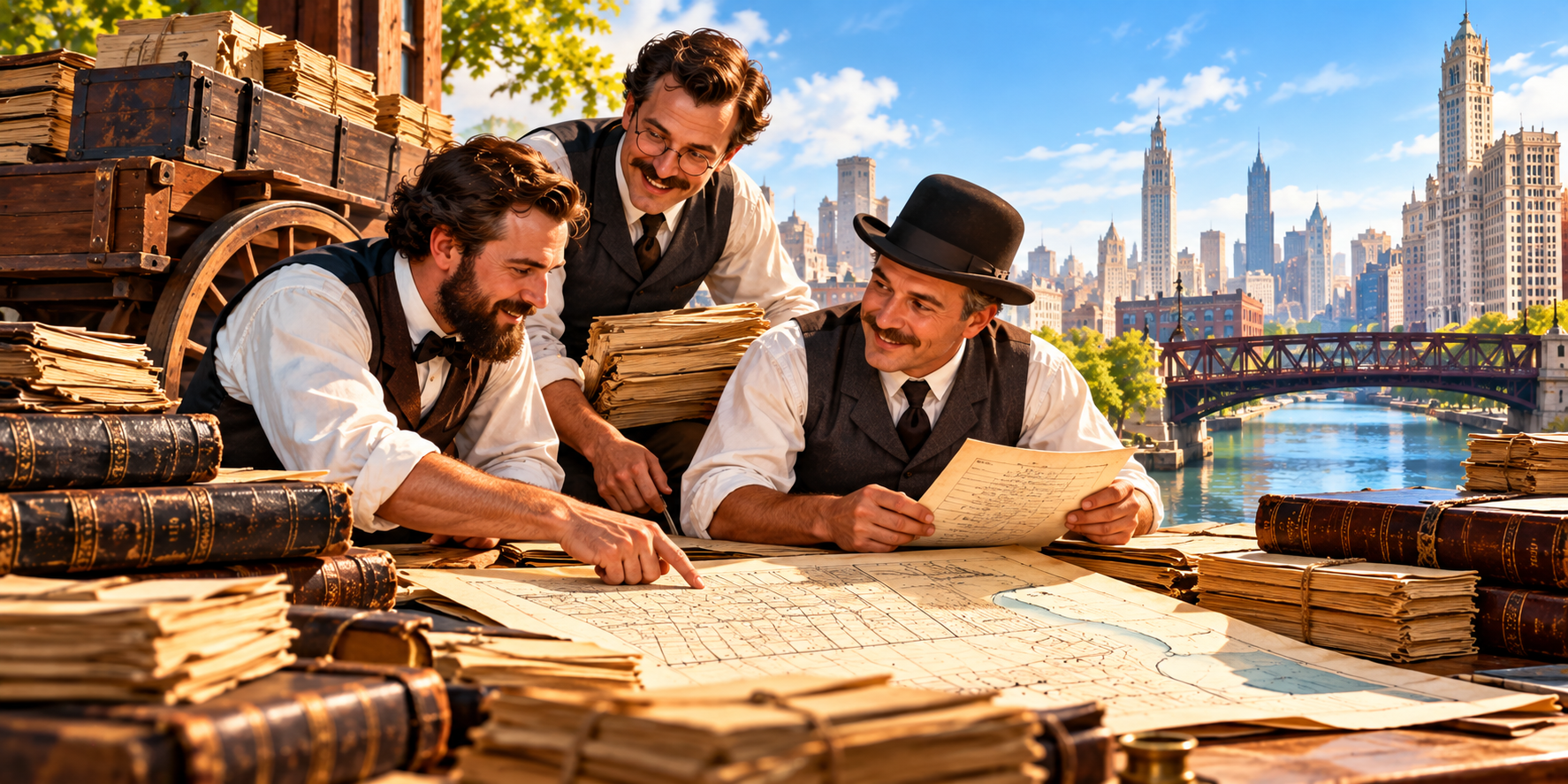
“What would you do if your only proof of ownership burned up in a fire?”
What would you do if your only proof of ownership burned up in a fire?
In October 1871, the Great Chicago Fire tore through the city for roughly two days, destroying thousands of buildings, including the combined Cook County courthouse and City Hall. The official real-estate records kept there were destroyed, leaving property owners with a serious problem. Homes, businesses and land still belonged to someone, but how could they prove it?
Three private abstract firms, Chase Brothers & Co., Shortall and Hoard, and Jones and Sellers, had kept their own records of property transactions. Their offices and records were separate from the courthouse, and much of their work survived the fire. Those documents became valuable evidence as Chicago worked to establish property ownership again.
One of the men behind that effort was John G. Shortall. According to a historical account from Chicago Title, Shortall even resorted to a revolver to get a wagon driver to help move records to safety as the fire approached. It was a desperate measure, but the records were worth saving.
In April 1872, Illinois passed the Burnt Records Act, allowing qualifying records obtained through private abstract companies to be used as evidence in court. It gave property owners a way to establish their claims even when the original government records were gone.
The aftermath also helped fuel interest in new approaches to proving ownership. In 1897, Illinois adopted the first Torrens Title Act in the United States, creating a different system for registering land ownership.
The fire is remembered for the city it destroyed, but the story of the records that survived reveals another part of Chicago’s recovery. Property ownership depends on more than the land itself. It depends on the documents that establish who owns it and how that ownership changed over time.
At Real Title Services, we follow those histories through public records every day. And as Chicago learned in 1871, sometimes the records that seem ordinary are the ones people need most.
Angela Sharp
0 Comments